Data Analytics Life Cycle
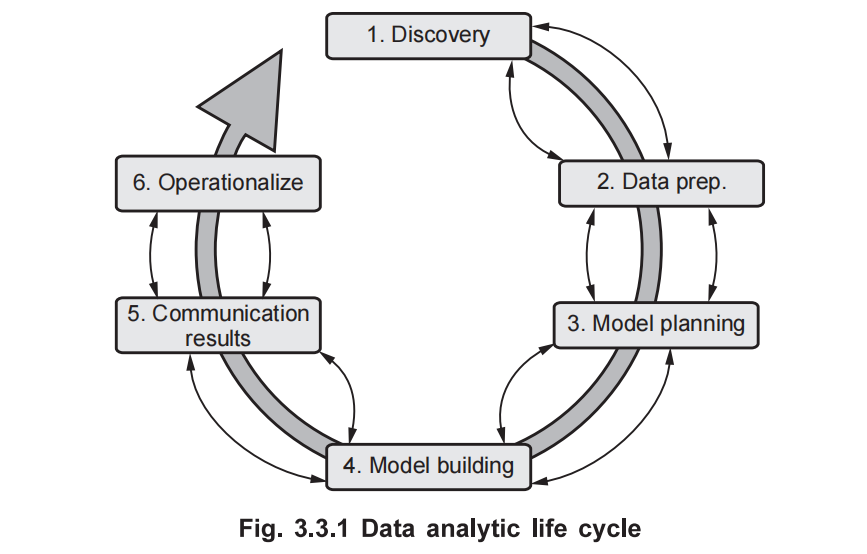
Overview :
The data analytics lifecycle is a structured approach designed for tackling big data problems and data science projects. It consists of six phases, each of which can occur simultaneously and iteratively. This cyclical nature allows for flexibility, as work can return to earlier phases based on new information uncovered during the process.
Mnemonic for Memorization
We'll use the first letter of each phase to create a memorable sentence:
- Discovery
- Data Preparation
- Model Planning
- Model Building
- Communication of Results
- Operationalize
Mnemonic Sentence: Dogs Dig Particularly Modern Parks, Making Bones Comically Rounded Often.
Key Phrases for Each Phase
-
Discovery
- Problem Understanding: Identify the business issue.
- Stakeholder Engagement: Gather requirements.
- Objective Setting: Define goals.
- Scope Definition: Establish project boundaries.
- Hypothesis Formulation: Develop initial hypotheses.
-
Data Preparation
- Data Collection: Gather data from sources.
- Data Cleaning: Handle missing values and outliers.
- Data Integration: Merge datasets.
- Data Transformation: Normalize and encode data.
- Feature Selection: Identify key variables.
-
Model Planning
- Model Selection: Choose appropriate models.
- Algorithm Review: Evaluate potential algorithms.
- Parameter Tuning: Set initial parameters.
- Validation Strategy: Plan for model testing.
- Resource Allocation: Assign necessary resources.
-
Model Building
- Model Design: Structure the model.
- Model Training: Fit model to training data.
- Model Testing: Validate with test data.
- Model Evaluation: Assess performance.
- Model Refinement: Optimize parameters.
-
Communication of Results
- Result Summary: Condense findings.
- Visualizations: Create charts and graphs.
- Stakeholder Presentation: Tailor results for audience.
- Report Writing: Document analysis.
- Actionable Insights: Provide recommendations.
-
Operationalize
- Deployment Plan: Implement model in production.
- Automation: Integrate into business processes.
- Monitoring: Continuously track performance.
- Maintenance: Regularly update models.
- User Training: Educate end-users.
Using the Mnemonic
- Dogs (Discovery)
- Dig Particularly (Data Preparation)
- Modern Parks (Model Planning)
- Making Bones (Model Building)
- Comically Rounded (Communication of Results)
- Often (Operationalize)
Related Question
Explain Data Analytics life cycle with the help of diagram.Explain Data Analytics life cycle with the help of diagram.Data Analytics Lifecycle: Overview The data analytics lifecycle is a structured approach to conducting data analytics projects from inception to completion. It encompasses various phases that involve understanding the business problem, preparing data, conducting analyses, and delivering actionable insights. This process helps ensure that the data analytics work is thorough, relevant, and aligned with business needs. The lifecycle concept is well articulated in texts like "Data Science & Big Dat