Texture Classification and Segmentation
Certainly! Here are the structured notes on "Texture Classification and Segmentation" within the domain of Artificial Neural Networks (ANN):
Texture Classification and Segmentation using Artificial Neural Networks
Definition
Texture classification and segmentation involve identifying and categorizing different textures in an image and partitioning the image into segments based on these textures. This task leverages Artificial Neural Networks, particularly Convolutional Neural Networks (CNNs), to analyze and classify textures, and to segment images accordingly.
Key Concepts
- Texture Classification: The process of categorizing regions of an image based on their texture patterns.
- Texture Segmentation: The process of partitioning an image into segments where each segment contains a homogeneous texture.
- Feature Extraction: The process of identifying relevant features from image data that can be used for classification and segmentation.
- Convolutional Neural Networks (CNNs): A class of deep neural networks particularly effective for image recognition and classification tasks.
- Patch-based Analysis: An approach where the image is divided into smaller patches, and each patch is analyzed separately.
- Fully Convolutional Networks (FCNs): A type of CNN designed for dense prediction tasks like segmentation.
Detailed Explanation
Texture classification and segmentation using ANNs typically involve the following steps:
-
Data Collection and Preprocessing:
- Collect a dataset of images containing various textures.
- Preprocess the images by normalizing pixel values and augmenting the data to increase variability.
-
Feature Extraction:
- Use CNNs to extract features from the images. CNNs can automatically learn relevant texture features through their convolutional layers.
-
Network Architecture:
- Input Layer: Receives the raw input image or image patches.
- Convolutional Layers: Extract features from the input through a series of convolutional operations.
- Pooling Layers: Reduce the dimensionality of the feature maps, retaining essential features while reducing computational complexity.
- Fully Connected Layers: Used for texture classification tasks to output class probabilities.
- Fully Convolutional Networks (FCNs): Used for segmentation tasks, producing pixel-wise predictions to create segmented images.
-
Training the Network:
- Use a labeled dataset of texture images to train the network.
- Employ a loss function such as categorical cross-entropy for classification or pixel-wise cross-entropy for segmentation.
- Optimize the network using algorithms like stochastic gradient descent (SGD) or Adam.
-
Validation and Testing:
- Validate the model using a validation set to fine-tune hyperparameters and prevent overfitting.
- Test the final model on a separate test set to evaluate its performance in classifying and segmenting textures.
-
Texture Classification and Segmentation:
- Use the trained network to classify and segment new images by feeding them into the network and observing the output predictions.
- For segmentation, the network produces a segmented image where each pixel is assigned to a texture class.
Diagrams
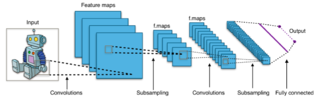

Links to Resources
- Texture Classification using CNNs
- Deep Learning for Texture Segmentation
- Fully Convolutional Networks for Semantic Segmentation
Notes and Annotations
-
Summary of key points:
- Texture classification and segmentation involve feature extraction, network design, training, and testing.
- Key concepts include texture patterns, CNNs, patch-based analysis, and fully convolutional networks (FCNs).
- Effective classification and segmentation require careful preprocessing, selection of network architecture, and hyperparameter tuning.
-
Personal annotations and insights:
- Using transfer learning with pre-trained CNNs can significantly reduce training time and improve performance, especially for texture classification tasks.
- Combining multi-scale feature extraction techniques with deep learning models can enhance the accuracy of texture segmentation by capturing both fine and coarse texture details.
Backlinks
- Artificial Neural Networks:
- Introduction to ANN
- Learning Algorithms
- Convolutional Neural Networks
- Applications of ANN
Feel free to expand on these sections with more detailed information or specific examples relevant to your studies or projects.