Recognition of Olympic Games Symbols
Recognition of Olympic Games Symbols using Artificial Neural Networks
Definition
Recognition of Olympic Games Symbols involves using Artificial Neural Networks to identify and classify the symbols associated with the Olympic Games, such as the Olympic rings, sports icons, and country flags. This process leverages the pattern recognition capabilities of ANNs to automate the identification and categorization of these symbols in various media.
Key Concepts
- Symbol Recognition: The process of identifying and classifying symbols from images or videos.
- Image Preprocessing: Techniques used to prepare images for analysis, such as resizing, normalization, and augmentation.
- Convolutional Neural Networks (CNNs): A class of deep neural networks particularly effective for image recognition tasks.
- Feature Maps: Representations of input data produced by convolutional layers in a CNN.
- Softmax Function: An activation function often used in the output layer of a classification network to produce probability distributions over classes.
- Transfer Learning: Using a pre-trained model on a new, related task to leverage existing learned features.
Detailed Explanation
Recognition of Olympic Games Symbols using ANNs typically involves the following steps:
-
Data Collection and Preprocessing:
- Collect a dataset of images containing various Olympic symbols.
- Preprocess the images by resizing them to a standard size, normalizing pixel values, and applying augmentation techniques to increase data variability.
-
Designing the CNN:
- Choose an appropriate CNN architecture (e.g., VGG16, ResNet).
- Design the network with convolutional layers for feature extraction, pooling layers to reduce dimensionality, and fully connected layers for classification.
-
Training the CNN:
- Use a labeled dataset of Olympic symbols to train the network.
- Employ a loss function such as categorical cross-entropy to measure classification error.
- Optimize the network using an algorithm like stochastic gradient descent (SGD) or Adam.
-
Validation and Testing:
- Validate the model using a validation set to fine-tune hyperparameters and prevent overfitting.
- Test the final model on a separate test set to evaluate its performance and accuracy.
-
Symbol Recognition:
- Use the trained CNN to classify new images of Olympic symbols by feeding them into the network and observing the output probabilities.
- The symbol corresponding to the highest probability is selected as the recognized symbol.
Diagrams
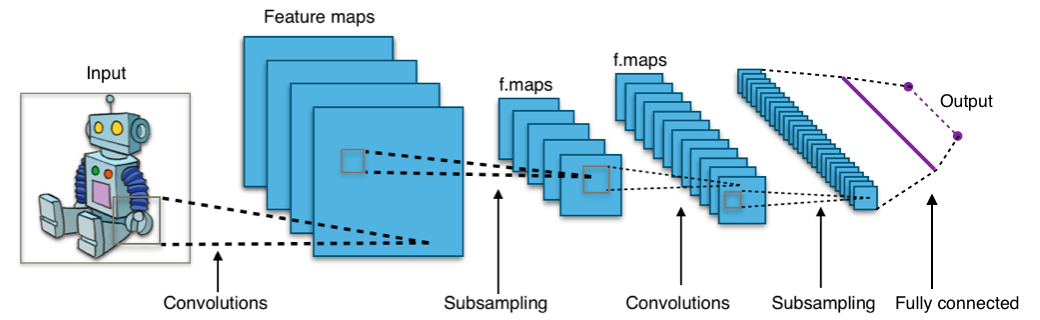
Links to Resources
- Convolutional Neural Networks for Visual Recognition
- Symbol Recognition Using Deep Learning
- Transfer Learning with CNNs
Notes and Annotations
-
Summary of key points:
- Recognition of Olympic symbols involves image preprocessing, CNN design, training, and testing.
- Key concepts include symbol recognition, CNNs, feature maps, and transfer learning.
- Effective recognition requires careful preprocessing, selection of network architecture, and hyperparameter tuning.
-
Personal annotations and insights:
- Transfer learning can significantly reduce training time and improve accuracy, especially when using models pre-trained on large datasets like ImageNet.
- Data augmentation techniques such as rotation, scaling, and flipping can enhance model robustness by providing diverse training samples.
Backlinks
- Artificial Neural Networks:
- Introduction to ANN
- Learning Algorithms
- Convolution Neural Network