Introduction to Associative Learning
Definition
Associative learning is a type of learning in which a relationship is formed between two stimuli or between a behaviour and a stimulus. This learning process is fundamental in understanding how behaviours are acquired and modified through experience.
Key Concepts
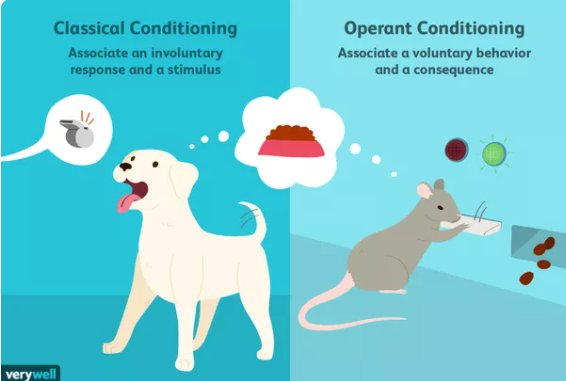
- Classical Conditioning: Learning through association between a neutral stimulus and an unconditioned stimulus to elicit a conditioned response.
- Operant Conditioning: Learning through reinforcement and punishment, where behaviour are modified based on their consequences.
- Hebbian Learning: A theory proposing that neurons that fire together wire together, emphasising the strengthening of synaptic connections through repeated stimulation.
- Pavlovian Conditioning: Another term for classical conditioning, named after Ivan Pavlov who first demonstrated this learning process.
- Reinforcement: A process in operant conditioning that increases the likelihood of a behavior by providing a rewarding outcome.
- Punishment: A process in operant conditioning that decreases the likelihood of a behavior by introducing an aversive outcome.
Detailed Explanation
Associative learning encompasses various learning processes where associations are formed between different stimuli or between behaviours and outcomes. The most well-known forms are classical conditioning and operant conditioning.
Classical Conditioning:
- Ivan Pavlov's Experiments: Pavlov demonstrated classical conditioning through experiments with dogs, where he paired the sound of a bell (neutral stimulus) with the presentation of food (unconditioned stimulus). Over time, the dogs began to salivate (conditioned response) to the sound of the bell alone.
- Key Elements:
- Unconditioned Stimulus (US): Naturally elicits a response (e.g., food).
- Unconditioned Response (UR): Natural response to the US (e.g., salivation).
- Conditioned Stimulus (CS): Previously neutral, becomes associated with the US (e.g., bell).
- Conditioned Response (CR): Learned response to the CS (e.g., salivation to the bell).
Operant Conditioning:
- B.F. Skinner's Research: Skinner expanded on the principles of operant conditioning, focusing on how behaviors are influenced by their consequences.
- Key Elements:
- Positive Reinforcement: Adding a rewarding stimulus to increase behavior (e.g., giving a treat for a trick).
- Negative Reinforcement: Removing an aversive stimulus to increase behavior (e.g., stopping a loud noise when a correct action is performed).
- Positive Punishment: Adding an aversive stimulus to decrease behavior (e.g., scolding).
- Negative Punishment: Removing a rewarding stimulus to decrease behavior (e.g., taking away a toy).
Hebbian Learning:
- Principle: "Cells that fire together wire together." Repeated stimulation of a neuron strengthens its connections, forming associations at the neural level.
Diagrams
Links to Resources
Notes and Annotations
-
Summary of key points:
- Associative learning involves forming connections between stimuli or between behavior and stimuli.
- Classical conditioning and operant conditioning are primary types of associative learning.
- Hebbian learning explains neural mechanisms underlying associative learning.
-
Personal annotations and insights:
- Understanding associative learning is crucial in fields like psychology, neuroscience, and artificial intelligence.
- Real-world applications include behavioral therapy, training animals, and designing adaptive AI systems.
- Pavlov's and Skinner's foundational experiments highlight the importance of systematic observation and controlled experimentation in studying learning processes.
By integrating these elements, one can gain a comprehensive understanding of associative learning and its implications across various domains.
Backlinks
- Linked from Unit III Associative LearningUnit III Associative LearningOverview Associative learning is the focus of this unit, which begins with an introduction to the concept and its significance in neural networks. You'll study Hopfield networks and their error performance, as well as simulated annealing processes. The unit covers Boltzmann machines and Boltzmann learning, including state transition diagrams and the problem of false minima. Stochastic update methods and simulated annealing are also discussed. Finally, the unit explores basic functional units of